Digital Worm (BAAIWorm)
BAAIWorm is the first executable digital organism that integrates the brain, body and environment of Caenorhabditis elegans into a closed‑loop system. Behaviours such as zigzag locomotion emerge naturally from the biological structure rather than being hard coded, demonstrating how coupled neural and biomechanical models can reproduce real animal behaviour.
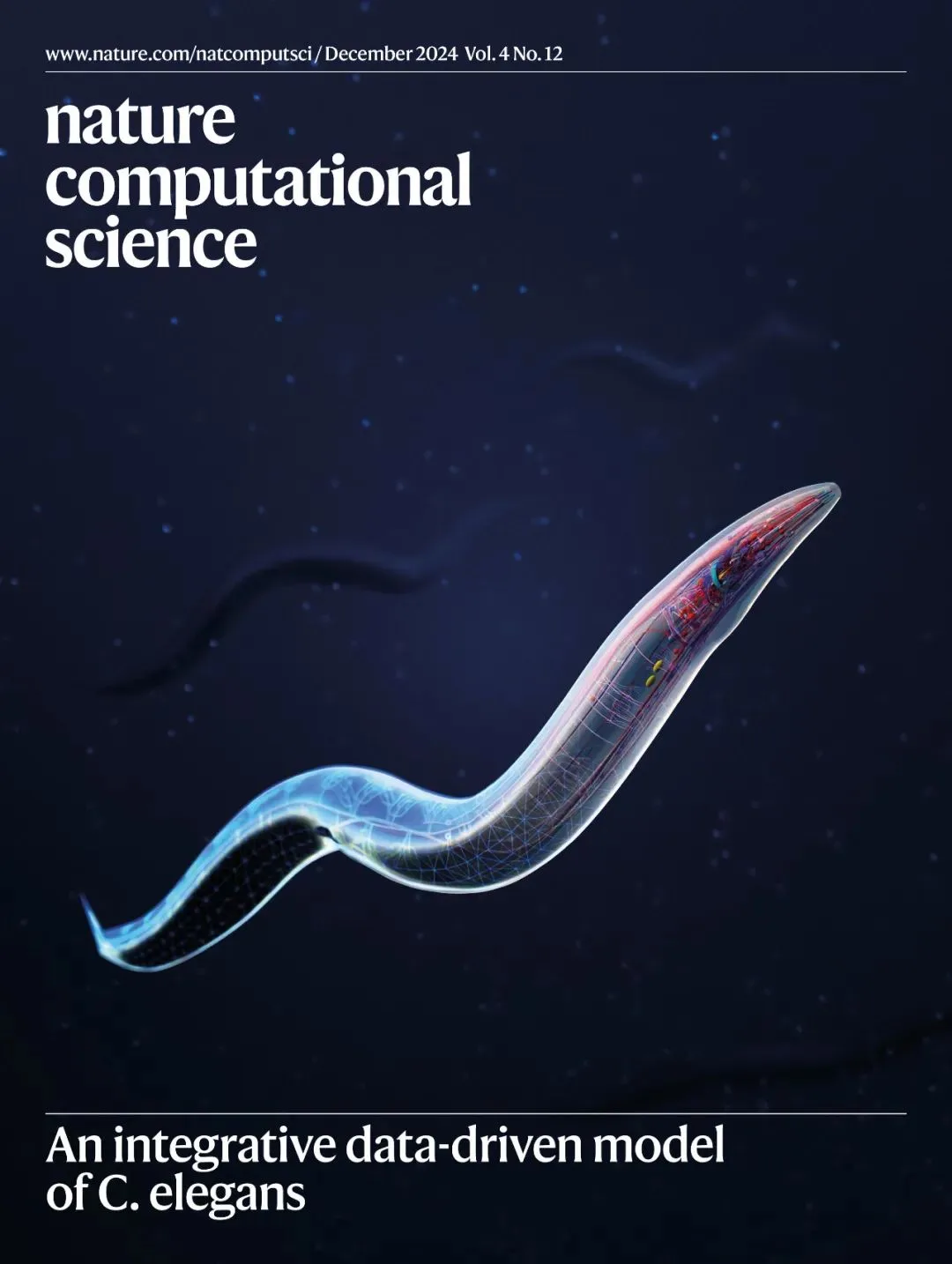
The project was developed by the Life Simulation Research Centre at the Beijing Academy of Artificial Intelligence under the leadership of Dr. Lei Ma. It has been highlighted as a milestone in digital life research and appeared on the cover of Nature Computational Science in 2024.
For public-facing context, see the project’s broader media coverage, including the CCTV News Live feature on BAAIWorm, the follow-up coverage on the Multimodal Trans-scale Biomedical Imaging Facility, and the original Nature Computational Science paper.
Model construction
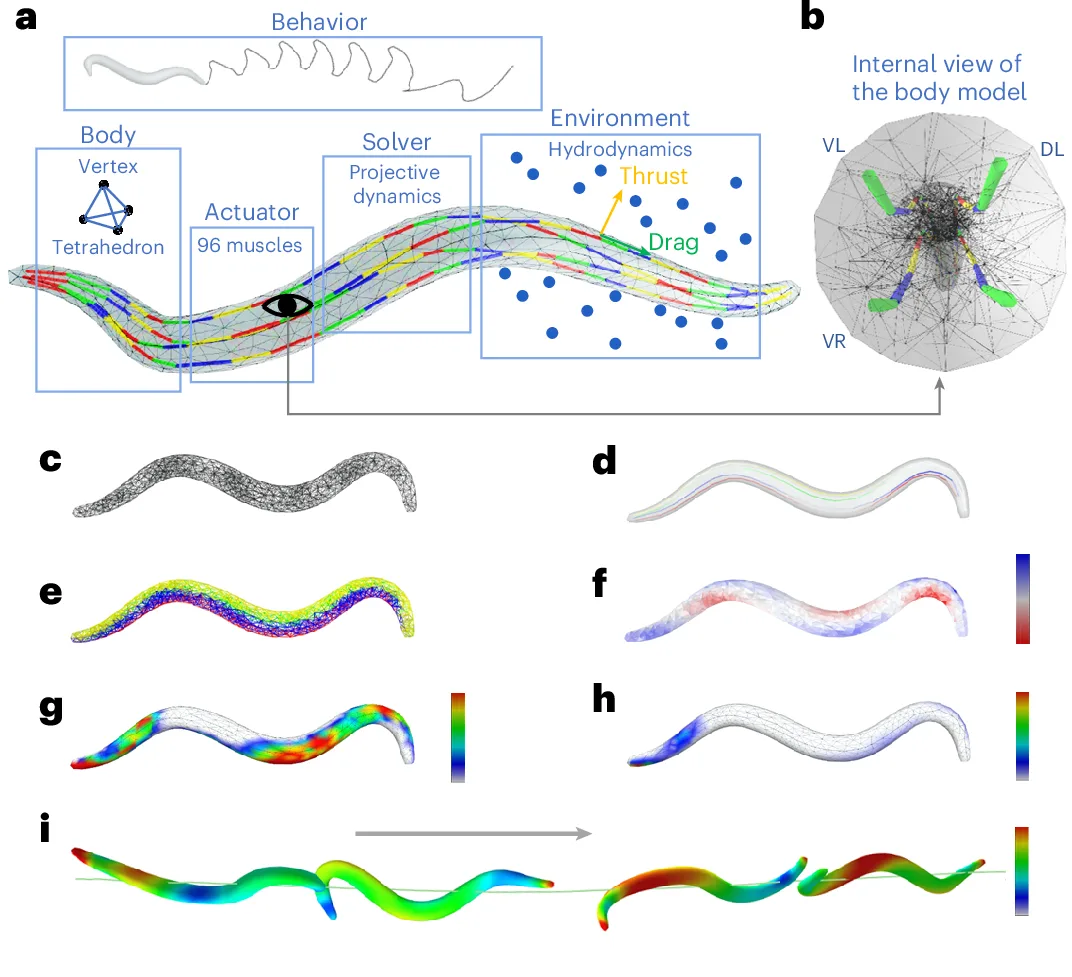
BAAIWorm is an open‑source, modular system composed of two data‑driven submodels: a biophysically detailed neural network and a lifelike body–environment model. Together they provide a versatile platform for investigating how neural circuits control embodied behaviour.
- Neural network. The brain model simulates all 302 neurons of C. elegans using multi‑compartmental neurons connected by synapses and gap junctions. Each compartment reproduces electrophysiological properties such as dendrites, soma and axon segments.
- Body & environment. The body model contains 96 muscles assembled from 3,341 tetrahedral elements and interacts with a three‑dimensional fluid environment that exerts thrust and drag. Continuous sensory inputs, such as a food concentration gradient, modify neural computations and drive muscle contractions.
- Closed‑loop feedback. Sensory signals from the environment feed back into the neural network, which in turn drives muscle activation to generate movement. This closed loop aligns the worm’s behaviour with environmental cues.
Research findings
Using an “electronic‑evolution” approach, the team iteratively optimised connection weights and polarities to align simulated behaviours with experimental data. The resulting model accurately reproduces characteristic locomotion patterns of C. elegans, including the zigzag motion used for chemotaxis.
To probe causal relationships, synthetic perturbation experiments altered synaptic and gap‑junction properties at specific sites or across the entire network. These manipulations changed neural dynamics and disrupted coordinated movement, demonstrating how the structure of the connectome governs behaviour.
Expert evaluations & impact
BAAIWorm has been widely recognised as a breakthrough in whole‑organism simulation. Editors and reviewers from leading journals describe the work as:
- “makes it possible to investigate how brain activity affects behaviour in a closed‑loop system” — Ananya Rastogi, Senior Editor, Nature Computational Science
- “an impressive body of work … consolidates physiology and anatomy into a coherent computational model” — Padraig Gleeson (University College London, OpenWorm)
- “a new research paradigm for understanding nervous systems as integrated wholes” — Ryota Kanai (Araya, neuroscientist)
- “a significant step forward in understanding embodied intelligence … highly original and impactful” — Konrad Kording (University of Pennsylvania, computational neuroscientist)
Beyond academic circles, BAAIWorm has featured in national‑level science communication, illustrating its role in shaping the emerging field of digital life.
Enduring impact & future directions
As an early result of the Digital Life initiative, BAAIWorm demonstrates that faithfully reproducing the interaction of neural dynamics, biomechanics and environment is both feasible and informative. Its open‑source and modular design allows researchers to extend and replace components, making the platform transferrable to other species and fostering collaboration. By providing a reusable framework for closed‑loop simulation, BAAIWorm paves the way toward digital organs, digital animals and ultimately a broader digital life programme.
Future work will incorporate additional connectome and behavioural data to improve biological realism and expand to more complex sensory modalities.